
Schemas: The Reasons Beneath the Patterns
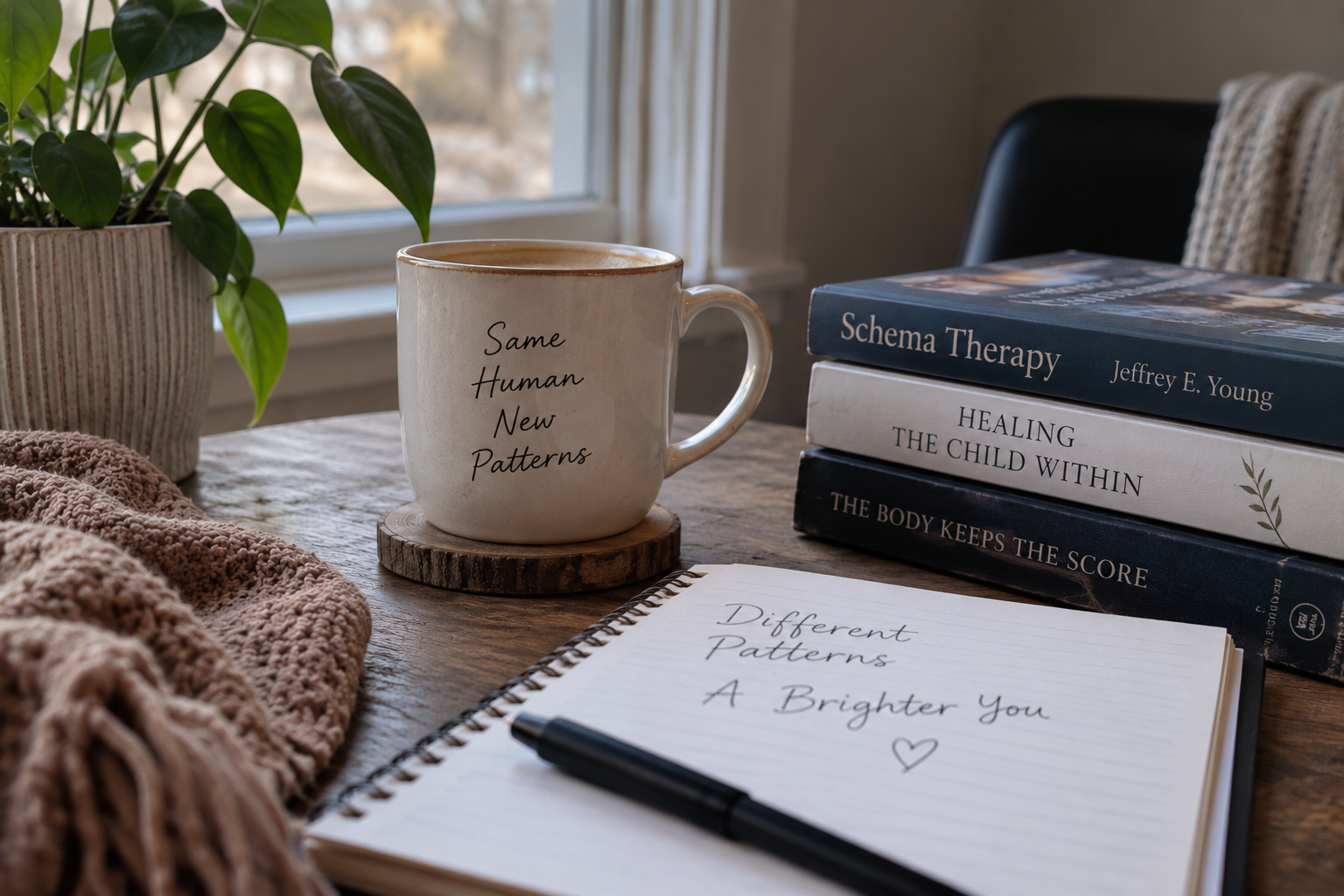
We all have patterns in the way we think, feel, and respond to the world around us. Some are obvious. Others are so familiar that we don't even recognize them as patterns.
It's the reaction that seems bigger than the situation. The criticism that somehow turns into shame. The unanswered text that sends your mind straight to something is wrong. The relationship you keep recreating even though you know, logically, that you want something different.
It's saying yes when you mean no. Taking responsibility for everyone else's feelings. Pushing yourself far beyond what is reasonable because slowing down feels like failure.
And sometimes the pattern isn't about anyone else at all.
It's the way you talk to yourself.
The inner critic that can be far more vicious than you would ever allow yourself to be with another person. The immediate assumption that you've screwed something up. The tendency to dismiss your own accomplishments, second-guess your decisions, or look at your life and decide you should be further along by now.
These things can feel like personality. Like instinct. Like this is just how I am.
But many of the patterns we carry aren't random, and they aren't necessarily an accurate reflection of who we are.
They're learned early in our childhood. When our brains are just starting to understand the world we were brought into.
Human beings have emotional needs. We need safety, stability, connection, acceptance, support, autonomy, and the opportunity to develop a healthy sense of ourselves. When those needs aren't consistently met, we adapt to the environment we're in.
When we grow up in a secure environment with caregivers who consistently meet our emotional, cognitive, and social needs, we typically develop a sense that the world is safe enough to navigate and that, when we need support, someone will be there to help us. If the environment is chaotic with caregivers who are unable or unwilling to meet our emotional, cognitive, and social needs; then we grow up with a vastly different view of the world around us.
We learn to adapt to the world we've been given. We become hyper-aware of other people's moods because knowing what was coming next feels important. We learn to rely on ourselves because depending on others hasn't always felt safe. We stop asking for things we don't expect to receive. We become careful about who we trust. We learn to hide parts of ourselves, suppress our emotions, keep the peace, or put other people's needs ahead of our own. We may become perfectionists, overachievers, people-pleasers, or fiercely independent because, somewhere along the way, those ways of being helped us feel safer, more accepted, or more in control.
At the time, those adaptations may have been useful. They helped us navigate whatever we were dealing with.
But an adaptation can outlive the circumstances that created it.
What once helped you cope can become a deeply ingrained way of interpreting yourself, other people, and the world around you. Eventually, it can stop feeling like something you learned and start feeling like the truth.
People leave.
People can't be trusted.
I can't handle things on my own.
Something bad is going to happen.
I'm not good enough.
My needs don't matter.
I have to get this right.
This is where schemas come in.
So, What Exactly Is a Schema?
The concept of schemas comes from psychologist Jeffrey Young, the founder of Schema Therapy. Young developed the theory of Early Maladaptive Schemas to explain persistent patterns in the way people understand themselves, other people, and the world around them.
A schema is essentially a deeply rooted mental framework that influences how we interpret our experiences. Our brains use these frameworks as a kind of shortcut, helping us make sense of what is happening and predict what is likely to happen next. The problem is that the brain makes those predictions based on what it has learned from past experiences. If what we learned was that people leave, criticism means we're failing, or our needs won't be met, we may begin to interpret new experiences through those expectations, even when the current situation is different.
A schema can shape what we expect from other people, what we believe about ourselves, what we notice, what we overlook, and how we respond when something feels emotionally significant. And because these patterns were built from our previous experiences, they don't always give us an accurate picture of what's happening in the present.
This is where the term maladaptive comes in. In Schema Therapy, an Early Maladaptive Schema is a pattern that may have developed as an understandable way of adapting to our early environment, but can continue to create problems long after that environment has changed.
The word maladaptive can sound harsh, but it isn't meant as a judgment. It doesn't mean you're broken, irrational, or incapable of functioning. It simply means that something that may have once helped you adapt isn't necessarily helping you anymore.
And that's an important distinction.
Because schemas don't usually develop for no reason.
How Schemas Develop
Human beings have fundamental emotional needs.
We need things like safety, stability, connection, acceptance, autonomy, realistic boundaries, emotional expression, and the opportunity to develop a sense of competence and identity.
When those needs are consistently met, we have opportunities to develop relatively healthy expectations about ourselves and our relationships.
We learn that other people can be trusted, but not blindly.
We learn that our feelings matter without needing every feeling to dictate our behavior.
We learn that mistakes are uncomfortable, but survivable.
We learn that we can depend on people while also developing the ability to function independently.
We learn that saying no doesn't automatically mean someone will leave us.
We learn that being imperfect doesn't make us unworthy of love or respect.
But when important emotional needs aren't consistently met, particularly during childhood, we adapt to what we're experiencing.
Sometimes the adaptation is obvious.
A child who grows up around unpredictable adults may become highly alert to changes in mood. A child who is repeatedly criticized may become extremely careful about making mistakes. A child whose needs are routinely dismissed may stop asking for them altogether.
Other adaptations are quieter.
You learn to be the easy child.
You learn not to need too much.
You learn that keeping the peace is safer than expressing yourself.
You learn to rely only on yourself.
You learn to work harder.
You learn to expect less.
You learn to stay small.
You learn to keep certain parts of yourself hidden.
At the time, these responses can make sense.
The problem is that our brains don't always know when the original situation has changed.
An adaptation that helped you navigate one environment can follow you into environments where it is no longer necessary.
Eventually, that adaptation can become a schema.
And once a schema is established, it can feel less like a strategy you learned and more like an objective truth.
People leave.
People can't be trusted.
I can't handle things on my own.
I'm not good enough.
My needs are too much.
Something bad is going to happen.
I have to be perfect.
Other people's needs matter more than mine.
Those beliefs can become the lens through which new experiences are interpreted.
Schemas Are More Than Negative Thoughts
This is where schemas can get confused with negative thinking.
A negative thought is a thought.
A schema is deeper.
Schemas can influence the thoughts you have, but they also influence the way you interpret situations, the emotions those situations trigger, the behaviors you choose, and even the kinds of situations you repeatedly find yourself in.
Imagine someone with a strong expectation that people will eventually leave.
A delayed text might not register as simply a delayed text.
Their brain may immediately start searching for evidence that something has changed.
They're pulling away.
I did something wrong.
They're going to leave.
The emotional response can then become much larger than the event itself.
Anxiety increases. The person may seek reassurance, become clingy, withdraw before they can be abandoned, become jealous, or start testing the relationship.
And then the other person may feel overwhelmed and pull back.
Now the original schema has new evidence.
See? People leave.
The schema isn't necessarily predicting reality accurately. It is influencing the person's interpretation of reality and their response to it.
This is one reason schemas can be so persistent.
They don't just sit quietly in the background.
They can shape the experiences we have and the meaning we assign to those experiences.
Schemas Can Affect the Relationship You Have With Yourself
This part is especially important because schemas aren't only about how we relate to other people.
They can profoundly shape how we relate to ourselves.
A schema can influence the way you speak to yourself, the standards you hold yourself to, the mistakes you believe you're allowed to make, and whether you treat your own needs as legitimate.
This is where negative self-talk often enters the picture.
Negative self-talk isn't itself a schema. It's one possible expression of a schema.
For example, someone with a strong Defectiveness/Shame schema may repeatedly tell themselves:
I'm stupid.
Something is wrong with me.
If people really knew me, they wouldn't want me.
Someone with Unrelenting Standards/Hypercriticalness may constantly hear:
That wasn't good enough.
I should have done better.
I should be further along.
Everyone else is doing more than I am.
Someone with Punitiveness may respond to mistakes with something much harsher:
I deserve to feel bad about this.
I should have known better.
I need to pay for what I did.
And someone experiencing Emotional Deprivation may not necessarily criticize themselves at all. Instead, they may simply stop expecting their own emotional needs to be met by anyone, including themselves.
This can contribute to something I often describe as self-abandonment.
Self-abandonment isn't one of Young's 18 schemas. It can be the way several schemas play out in a person's life.
You may abandon your own needs because you've learned that your needs don't matter.
You may silence yourself because expressing what you want feels unsafe.
You may constantly prioritize everyone else because being useful feels safer than being vulnerable.
You may reject yourself before someone else has the opportunity to reject you.
The result can look like a person who is incredibly compassionate toward everyone around them while being relentlessly unforgiving toward themselves.
That's not necessarily because they don't know how to care.
They may simply have learned that everyone else's humanity deserves compassion except their own.
Why Do Schemas Stick Around?
One of the frustrating things about schemas is that knowing something isn't necessarily enough to change it.
You can logically understand that you're worthy of love and still feel deeply defective when someone criticizes you.
You can know that your partner hasn't given you any reason not to trust them and still feel anxious when they become distant.
You can understand that making a mistake doesn't make you a failure and still feel an intense wave of shame when you get something wrong.
Schemas operate at a deeper level than a single conscious thought.
They're built from repeated experiences, emotional learning, and the meaning we made from those experiences.
And because schemas influence what we pay attention to, they can also become self-reinforcing.
If you expect rejection, you may notice signs of rejection more readily than signs of acceptance.
If you expect failure, you may focus heavily on your mistakes and discount what you do well.
If you expect other people to take advantage of you, neutral behavior may look suspicious.
If you believe your needs are less important than everyone else's, you may repeatedly put yourself in situations where your needs go unmet.
Then the outcome can seem to confirm the original belief.
This is part of why changing a schema usually involves more than simply replacing I'm not good enough with I'm amazing.
The deeper work is understanding where the belief came from, recognizing when it becomes activated, examining whether it actually fits the present situation, and developing different ways of responding.